

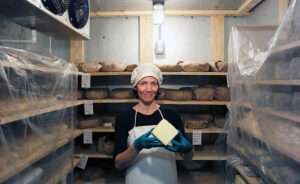
 “Cheese is a taste of place,” says Louella Hill, owner and head cheesemaker of Ballerino Creamery, a Staunton-based creamery that sources milk exclusively from Augusta County farms.
Louella would know: her love of dairy has spanned continents, moving from pasture to creamery to market and back. Born in a mining town on the U.S. and Mexican border, Louella grew up eating raw milk queso fresco. In college, she made her way to a sheep farm in Tuscany, where she first witnessed the transformation of fresh milk into fragrant wheels. From there she began a 20 year cheese journey that has included apprenticeships in Europe, Mexico, and New England.
“Dairy is so special within agriculture,” says Louella. “You must milk every single day. It is so perishable, it can’t be frozen, it’s bulky and heavy. It’s like having a truckload of watermelons that last for only three hours — it’s that level of urgency. It requires an intense devotion to solving delicate, complex problems.”
Louella’s opportunity for complex problem solving arrives daily, right out of the udder. She warms the milk, inoculates it, allows it to ripen, adds rennet to set it, lovingly separates the curds from the whey, and pours it into cheese forms, all before curing, salting, turning, brushing, and aging it. “We are dealing with the microscopic world, releasing bacteria, yeast and mold into a delicate broth, trying to coax out a cheese that we will recognize the character of,” she says. “To ask food to last through time, that takes an effort. Turning milk into cheese, we’re asking it to stay, to improve, from several weeks to over a year. It’s astonishing to me. Cutting open wheels that were made the year before, it’s a time capsule of flavor.”
“By creating a partnership with a local dairy farm, we create an opportunity for a reroute into local systems. We get to take that drop of milk that comes from grass in Augusta County, and we turn it into cheese that lands on an Augusta County table. We can literally taste the land we live on. Is there anything more radical, more beautiful?”
Nourishing Community
Louella’s journey to Augusta County began when her partner accepted a job in Charlottesville, on the eastern side of the Blue Ridge Mountains. But as Louella went to the Virginia Department of Agriculture and looked up dairy farms near his job, she quickly realized she needed to be here in the Shenandoah Valley.
“My life has been spent around food and farmers. It feels very natural, comforting even to be surrounded by the people making food. I want to be more of a producer than a consumer, and that’s Augusta County. We make things here; these are the people I want to be near.”
Her journey found its home in an empty industrial building that once held Augusta Dairies, a creamery that closed in the 1960s. Louella still sees old timers who can remember dropping off milk here. She works in the room where they once made cottage cheese, one of the products in addition to milk, cream, and butter that the Augusta Dairies creamery delivered to the surrounding community. For Ballerino Creamery, their home here is just one step among many to restoring vibrancy to the local food economy.
“It’s harder and harder to justify using land to make food. It’s harder to compete with planting houses on land, which are always the last crop. A part of the solution is reminding people on a daily basis that food comes from this land, that we need this land for agriculture,” says Louella.
For Louella and her family, that work of restoration includes their time at the Staunton Farmers Market, where her 10 and 12 year old sons help sell cheese.
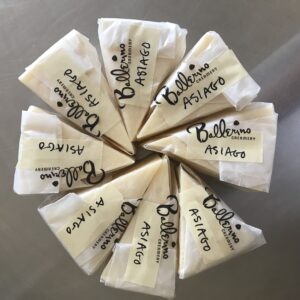
“We cut wheels just prior to selling them,” says Louella. “Cheese is a living, breathing thing. The cheese in stores is different: it’s been shrink wrapped for months, even years. But we know cheese is a living, breathing thing. When we open a wheel, the aroma compounds are pungent and brief. It’s the equivalent of fresh strawberries.” Visit early: unsurprisingly, Ballerino Creamery sells out regularly.
For Ballerino, the market is the moment of homecoming for their cheese, the closing of a circle that starts with the land and ends with community. “I’m always struck by the essentialness of the farmers market itself, the human exchange that it engenders. The act of having a farmers market is as nourishing as the food that is exchanged there,” says Louella. “We remember that we need each other. There is so much dignity in that fact.”